

After several difficult years for biotech listings, the U.S. IPO market is moving again. The 2026 cohort also makes one thing clear: access to public capital remains selective.
Through August 19, 20 therapeutics-focused biotechnology companies had listed on U.S. exchanges, raising a combined $6.10 billion in base IPO gross proceeds. The five largest offerings alone raised $2.48 billion, equivalent to 40.6% of the cohort total.
The size of these transactions is notable. So is the type of company that reached the market. Most were not using an IPO to fund early discovery alone. Fifteen of the 20 had a lead programme at approximately Phase 2 or later, were Phase 3-ready, or had reached regulatory review.
Below you can find a full list of U.S. IPOs and main observations.
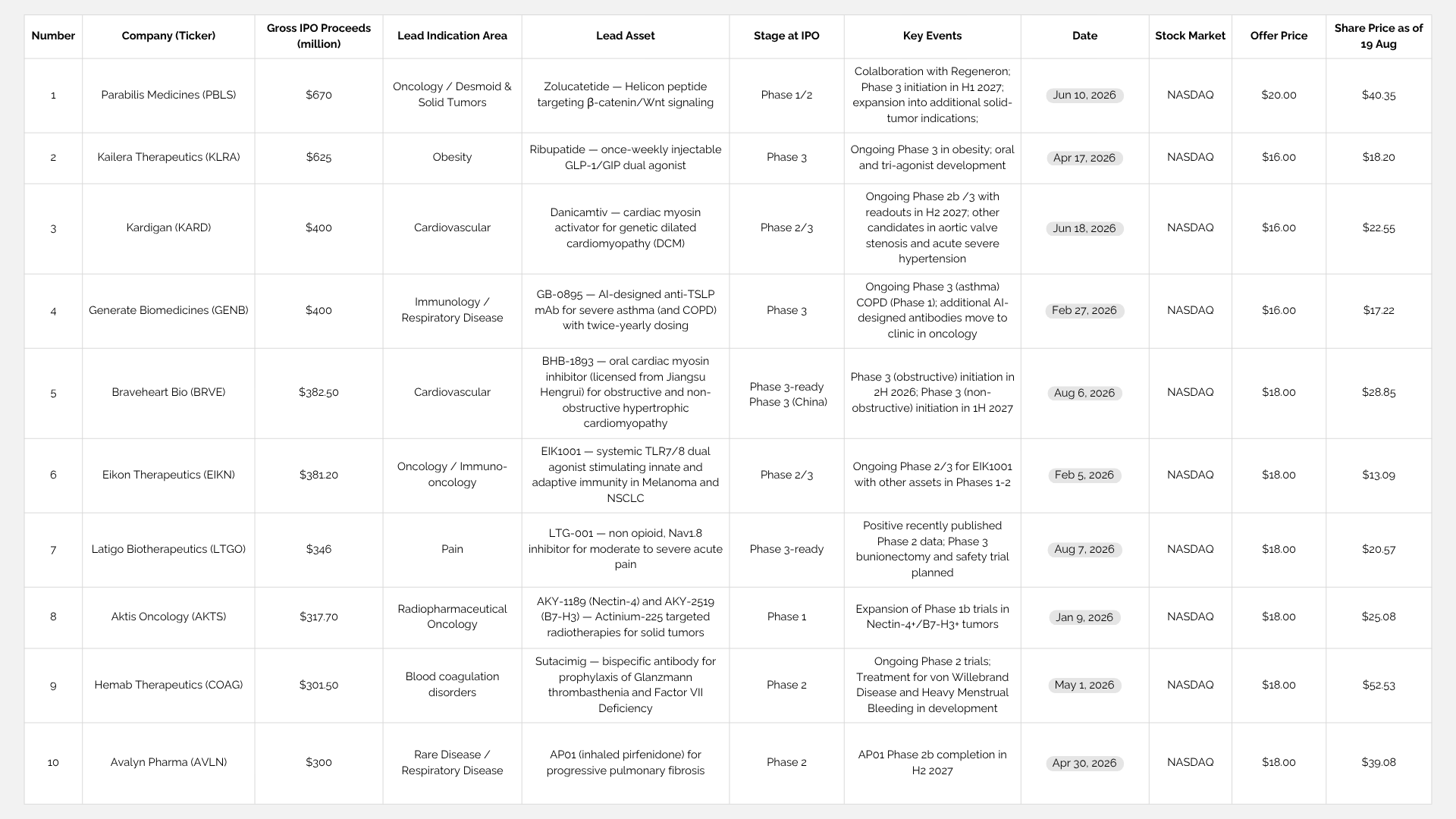
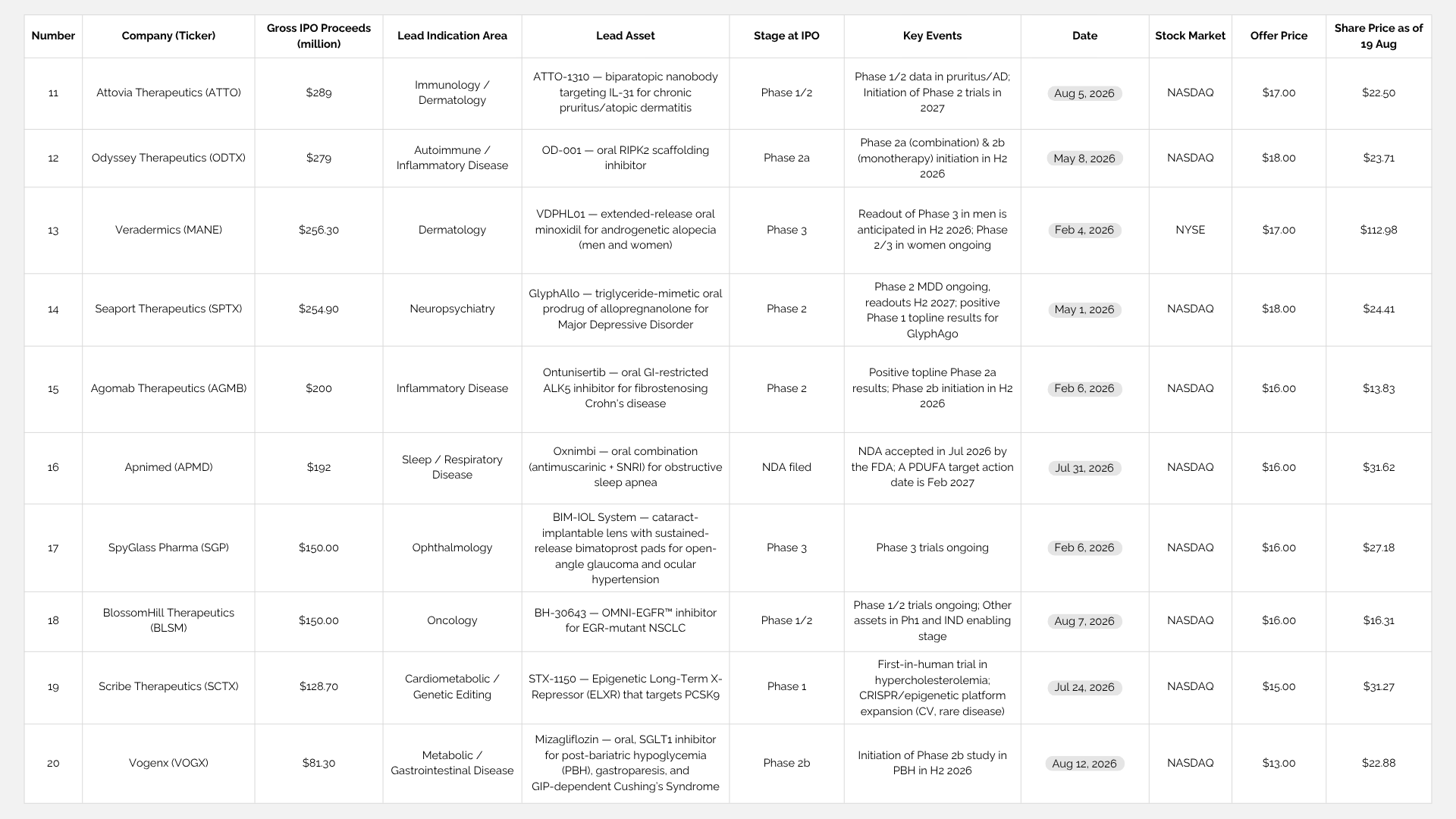
Note: The ranking uses announced base IPO gross proceeds before underwriting costs.
A biotech IPO record was broken twice
The year began with a record that had stood since Moderna’s $604 million IPO in 2018. In April 2026, obesity-focused Kailera Therapeutics surpassed it with a $625 million offering. The record lasted less than two months.
In June, Parabilis Medicines raised $670 million in its base offering, making it the largest new stock sale by a venture-backed biotechnology company on record. Full exercise of the underwriters’ option subsequently increased Parabilis’ IPO proceeds to $770.5 million. A separate $75 million private placement with Regeneron is not included in either the base IPO ranking or the IPO total used in this analysis.
Capital was directed towards clinical execution
Fifteen of the 20 companies had a lead programme at approximately Phase 2 or later, were ready to enter Phase 3, or had reached regulatory review. For instance, Apnimed has already filed an NDA for their Oxnimbi - the first dedicated oral pill designed specifically to treat the neuromuscular cause of obstructive sleep apnea.
Only five companies entered the market with lead programmes primarily in Phase 1 or Phase 1/2 development. But they brought broader pipelines and differentiated platforms beyond a single early-stage asset.
This suggests that the dominant role of the 2026 IPO was to finance clinical execution: pivotal studies, regulatory preparation, manufacturing and the next major value inflection point. It was generally not a discovery-stage financing event.
No therapeutic area dominated the space
The 2026 U.S. IPO cohort was therapeutically diverse with no concrete theme attracting a disproportionate share of attention.
Nevertheless, oncology was the largest clearly defined cluster still, represented by four companies: Parabilis, Eikon, Aktis and BlossomHill. Cardiovascular and cardiometabolic development followed with three: Kardigan, Braveheart Bio and Scribe.
The remaining companies covered a broad spectrum: respiratory and sleep disorders, immunology and inflammation, dermatology, pain, neuropsychiatry, ophthalmology, rare bleeding disorders and metabolic disease with including obesity.
Additionally, there was also no single dominant modality. The cohort included a vast range from small molecules and antibodies to radiopharmaceuticals and nanobodies.
The common denominator was therefore not one therapeutic area or technology. It was the ability to connect a differentiated programme with a credible development plan.
Several companies pursue first or differentiated options, but not all are first-in-class
A number of the companies targeted indications with limited treatment options or sought meaningful differentiation within an existing class.
For example, Kardigan is developing a potential first therapy directed at the underlying sarcomeric defect in genetic dilated cardiomyopathy, Vogenx is targeting post-bariatric hypoglycaemia, an area with limited approved options, and Veradermics is pursuing a potentially first FDA-approved oral treatment for pattern hair loss.
Thus, it would be too broad to describe the cohort as uniformly first-in-class. A more accurate pattern is a mix of first-in-indication opportunities and differentiated entrants into already validated mechanisms.
Full over-allotment exercises added approximately $530 million
Ten of the 20 companies had confirmed full exercises of their underwriters’ over-allotment options: Parabilis, Kailera, Kardigan, Braveheart Bio, Aktis Oncology, Hemab, Avalyn, Veradermics, SpyGlass and Scribe.
Together, those exercises added approximately $529.8 million to the original base offerings, increasing known aggregate proceeds for the cohort from $6.10 billion to at least $6.63 billion.
The existence of an over-allotment option is not itself evidence of exceptional demand; it is a standard feature of many IPOs. Full exercise is more informative, particularly when accompanied by an upsized transaction, pricing at or above the proposed range or a strong market debut.
For that reason, the base-offering figures remain the cleanest basis for comparing the original size of the 20 IPOs. The proceeds after confirmed exercises provide a useful secondary view of how the transactions developed.
What does the U.S. 2026 cohort tell us?
The U.S. biotech IPO market is awake again and active.
Capital has been concentrated in relatively large offerings and companies with programmes approaching meaningful clinical or regulatory milestones. At the same time, investor interest has extended across therapeutic areas and modalities rather than gathering around one dominant technology.
The largest transactions combined three characteristics: clinical maturity, a differentiated programme and a clear reason for raising substantial capital. In 2026 so far, those factors appear to have mattered more than therapeutic area alone.